

Heybike 72V V1 Pro Review: Big Torque, 49 MPH GPS, and a Wheelie Assist That Still Feels Half-Baked
November 28, 2026
Some links in this article may be affiliate links. If you buy through them, we may earn a small commission at no extra cost to you.
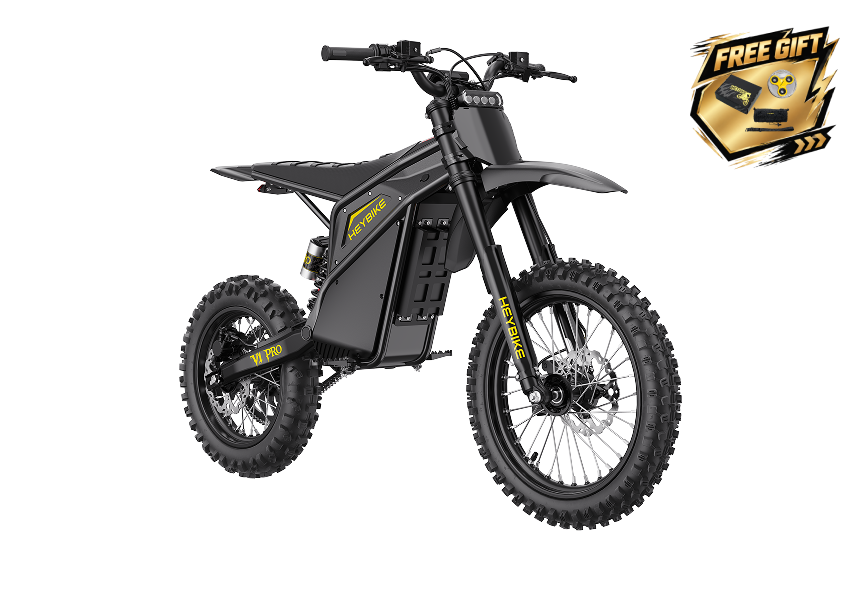
The Heybike 72V V1 Pro is the kind of bike that makes you grin before you even ride it. Not because it’s flashy (it isn’t), but because the formula is exactly what a lot of us keep asking for: a small-ish electric dirt bike with real voltage, real torque, and a controller you can actually tune.
It also comes with “wheelie assist,” and that’s the feature I was most curious about—because on paper it sounds like a cheat code, but in real life these systems can be… weird.
After spending time setting it up, playing with the app, doing GPS speed runs, and getting it dirty off-road, here’s where the V1 Pro nails it—and where it still needs some refinement.
First impressions: like the Villain, but scaled up where it counts
At a glance, the V1 Pro looks a lot like the original Heybike Villain I rode previously. Same overall vibe. Same mini dirt bike silhouette.
But the stance changes the second you get near it.
The V1 Pro runs a 17-inch front wheel and 14-inch rear (versus the Villain’s smaller setup), and that alone makes it feel less like a toy and more like a legit midsize mini. It sits taller, looks taller, and for taller riders that matters immediately.
Build-wise, a few things stood out right away:
The moto-style seat surprised me in a good way. The ribbed cover is actually grippy, which is not something you always get at this price point.
The integrated tail light with brake functionality is clean.
The overall layout feels familiar and straightforward—dirt bike saddle, standard pegs, dirt bike fenders, and that compact “play bike” footprint.
This is also a carbon steel frame bike, and the claimed weight is about 119 lb. On the ground, it feels in that ballpark: not featherweight, but still manageable and very flickable.
Controls and cockpit: a great display, plus some odd choices
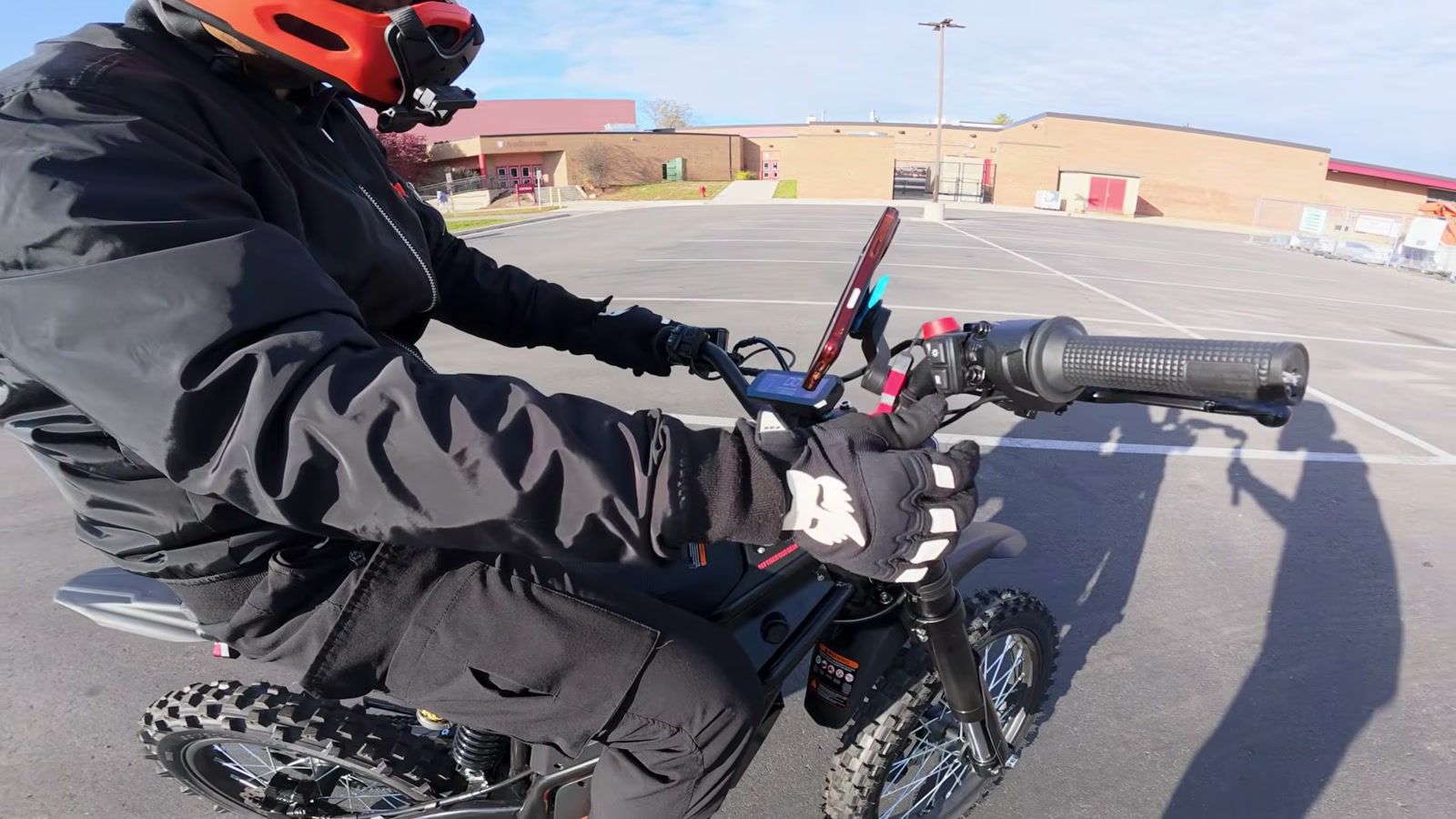
The center display is one of my favorite “small” details on the V1 Pro. It’s a bright, rectangular color unit that’s easy to read at speed. It looks modern without trying too hard.
There’s also a magnetic kill switch, which I like on anything that encourages shenanigans.
Where I didn’t love the layout: the reverse button.
Reverse is genuinely useful on a bike like this—especially when you’re maneuvering on trails, backing out of a tight spot, or moving it around in a garage. But Heybike placed the reverse button in a spot where you have to hold it while twisting the throttle in a way that just feels more awkward than it needs to be. It works, but I would’ve preferred reverse control placement that’s easier to hold while your throttle hand does throttle-hand things.
Battery access: not quick-removal (and that matters in winter)
The V1 Pro runs a 72V 27Ah battery, and yes, the higher voltage is the headline here.
But it’s not a quick-removal battery.
To pull it out, you’re removing a metal plate (four bolts), sliding the pack out, and disconnecting the charging and discharge ports. You can also remove side panels if you need more access.
That’s fine if you treat this like a garage-stored dirt bike.
It’s a hassle if:
You live somewhere cold and want to bring the battery inside
You’re storing it in a shed
You’re someone who regularly removes a battery to charge indoors
For warm climates or garage owners, you might never care. For winter riders, it’s a real convenience hit.
The app and FarDriver tuning: the real secret weapon
This bike’s personality changes dramatically depending on how you set it up.
The V1 Pro uses a FarDriver controller with Heybike app integration, and that opens up the kind of tuning you normally don’t see on “budget” electric dirt bikes.
In the app, I could adjust things like:
Throttle mode (linear / sport / eco)
Acceleration sensitivity
Regenerative braking behavior (including a true free-coast feel)
Power output by gear (low / middle / high)
Speed limit percentages by gear
Reverse speed
This isn’t just fiddling for the sake of fiddling. On a bike with this much low-end torque, tuning determines whether it feels smooth and predictable—or like it wants to pogo-stick the front wheel every time you breathe on the throttle.
One practical tip from my time with it: after saving changes, I found it best to back out of the settings screen before riding. It kept things more consistent versus trying to ride while still sitting inside the settings menus.
Acceleration and power delivery: 72V makes it feel alive
The first ride is where the V1 Pro immediately separates itself from the lower-voltage mini crowd.
Even in the lower modes, there’s a liveliness to the throttle that you just don’t get from 48V bikes—and it’s a noticeable step up from the original Villain’s 52V setup.
The V1 Pro also runs a direct chain drive (420 chain) with a huge 66T rear sprocket. In real riding terms, that means:
Strong low-end pull
Easy wheel lifts (even when you’re not trying)
A torque-forward feel that makes it fun in tight areas
The trade-off is that gearing choice also helps explain why top speed isn’t wildly higher than what I measured (more on that below). If someone wanted to chase speed, a sprocket change would likely be part of the conversation.
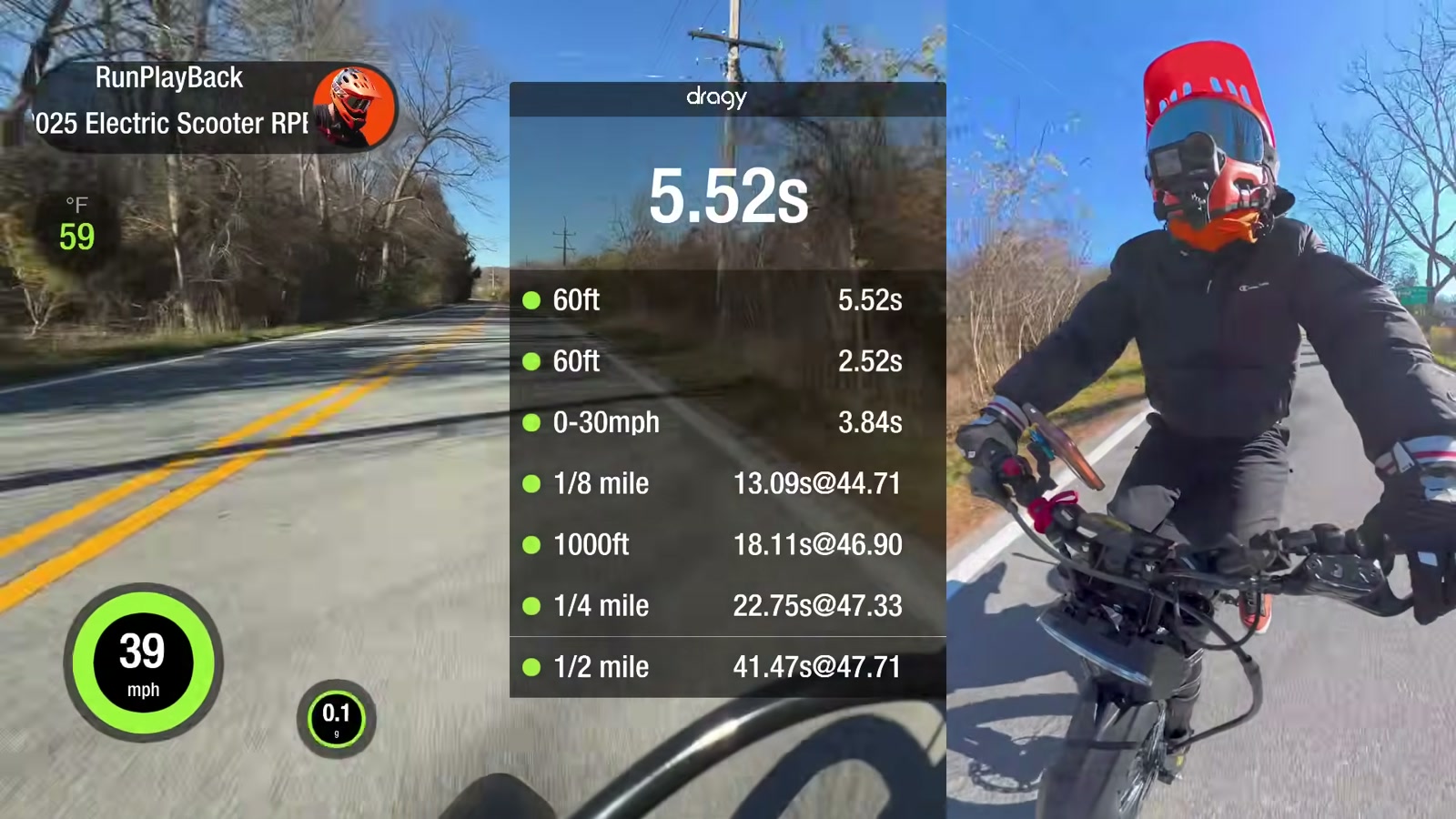
GPS top speed testing: 47–49 mph in the real world
Heybike advertises 50 mph.
In my GPS testing, I repeatedly saw the bike top out around 47 mph, with a best run touching 48–49 mph (I was able to flirt with 49 on a downhill).
So no miracle numbers, but it’s essentially right there.
More important than the last couple mph: the bike feels punchy and responsive getting up to speed, which is what makes it fun. It’s not just “it goes 49.” It’s “it gets there with attitude.”
Handling: still nimble, even with the bigger wheels
One of my favorite parts of this bike is that it keeps the mini-bike playfulness even after scaling up the wheels.
In parking lots, on gravel, and weaving around rough patches, it stays easy to maneuver. It doesn’t suddenly feel like a heavy e-moto. It feels like a small dirt bike with real torque.
That combination—nimble chassis + 72V snap—is the V1 Pro’s main hook.
Braking: powerful up front, underwhelming in the rear
The hydraulic brakes have a very clear personality: the front brake is strong.
Like, really strong.
The first time I got on the brakes hard, the front felt significantly more powerful than the rear—enough that I had the immediate thought: you could absolutely pitch yourself forward if you’re not careful.
For a lot of riders, a strong front brake is a plus.
For the way I ride these bikes—where rear brake control matters for wheelies and quick corrections—I wanted more rear brake authority. Personally, I’d rather have the bigger braking power bias at the rear on a bike like this, and I even found myself thinking I’d swap the stronger caliper setup to the rear if I were building this into a stunt-friendly rig.
The brakes work. They stop the bike.
But the balance feels front-heavy.
Suspension: front travel feels good, rear shock feels stiff
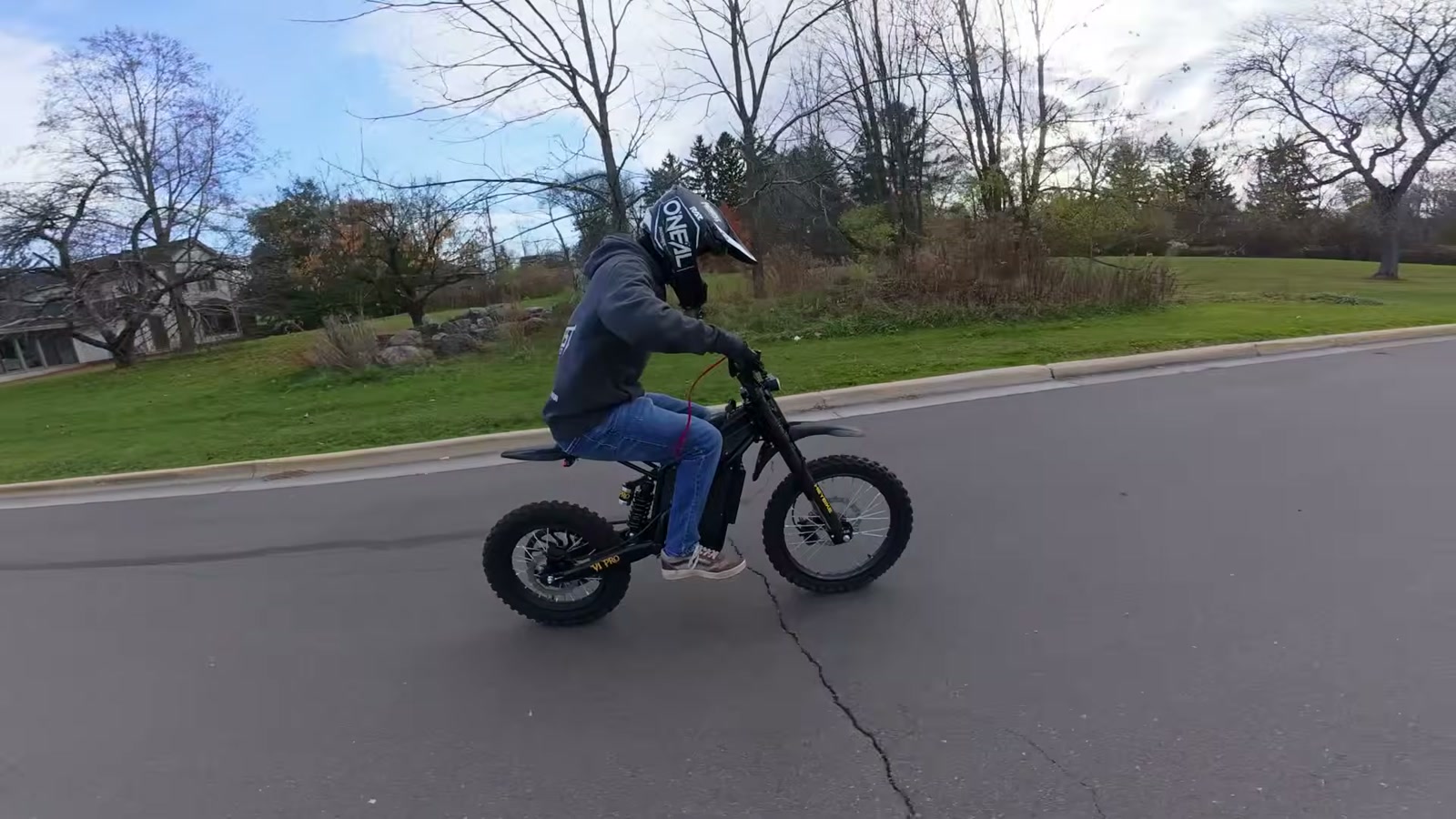
Up front, the fork has a decent amount of travel and felt capable when I took it off pavement. There aren’t adjustments on the front fork, but the feel in dirt/grass/off-road situations was encouraging.
The rear is where I struggled a bit.
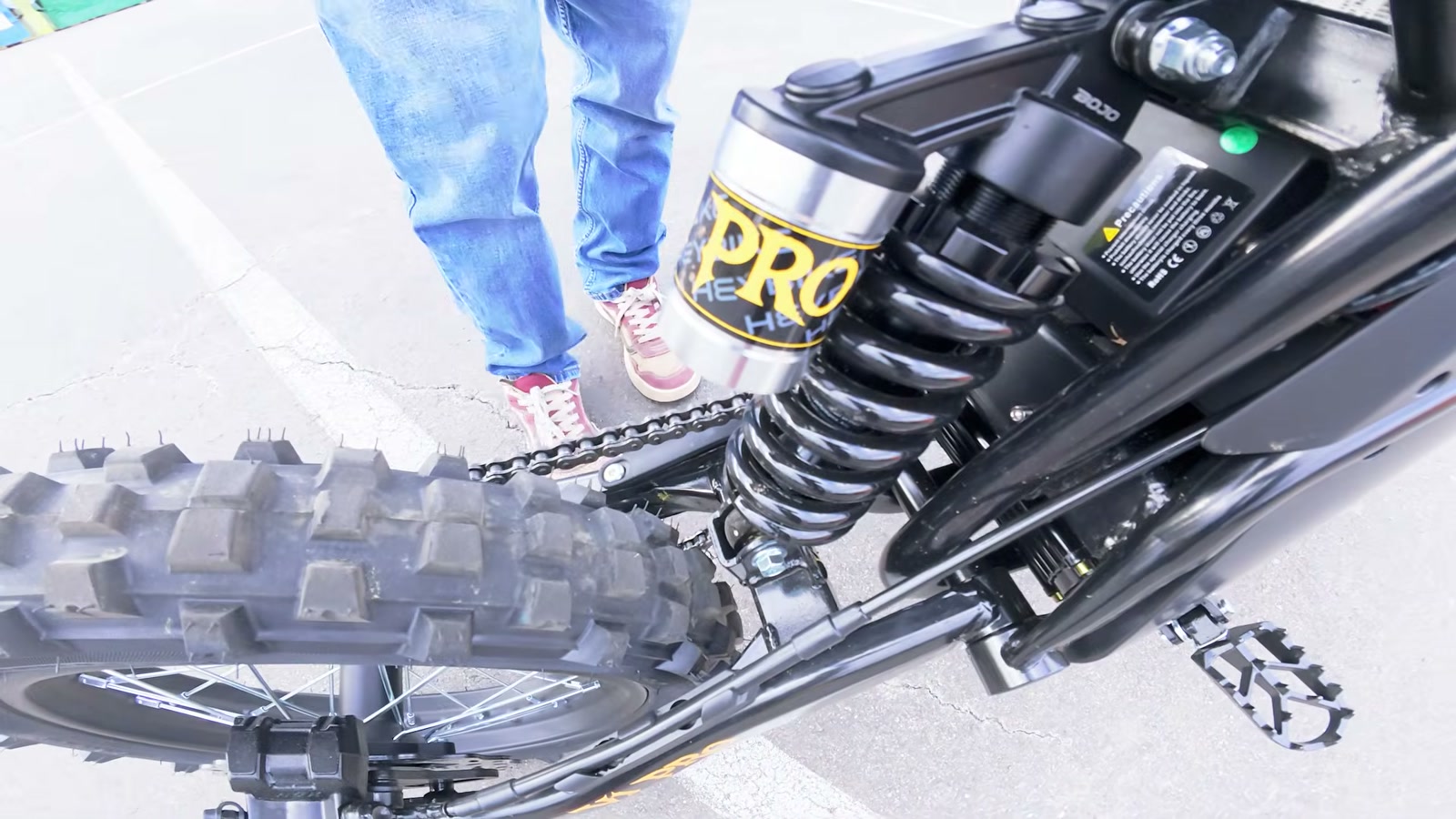
The V1 Pro uses a 40mm rear shock with preload adjustment, and for my weight it felt stiff. That stiffness shows up in a few ways:
Off-road, it can feel harsh over chatter
When trying to wheelie smoothly, the bike feels less settled
It makes the bike feel a little “jolty” instead of flowing
The upside is that preload is adjustable, and shocks are one of the easiest things to swap if you end up falling in love with the platform.
Also, I can see it improving after break-in time, because the hardware itself doesn’t feel cheap—it just doesn’t feel dialed for me out of the box.
Wheelies without assist: yep, it’ll wheelie all day
If you want to wheelie this bike normally (without stunt mode), the ingredients are absolutely there.
In the higher power modes, it has plenty of pop and plenty of power to carry a wheelie.
But the same thing that makes it fun also makes it tricky: it’s touchy.
When I started tuning, I lowered low-end power to calm it down, adjusted acceleration sensitivity, and set regen to none so it would coast better. Those changes helped, but the V1 Pro is the kind of bike where every small adjustment is noticeable. That’s good—it means the tuning actually works—but it also means it can take time to find your perfect setup.
If you’re a rider who loves dialing in a throttle curve and fine-tuning behavior, this bike is a playground.
If you want “set it and forget it,” expect a learning curve.
Wheelie assist / stunt mode: useful idea, inconsistent execution
The V1 Pro has four modes, with the fourth being stunt mode with wheelie assist.
You can also set the wheelie angle through the display (I was working with a max of 40°).
Here’s the honest take: wheelie assist still feels gimmicky.
Even after cranking settings—acceleration sensitivity up, gear power up, basically giving it everything—it often struggled to reach and hold that claimed 40° angle consistently.
When it did finally hit the angle, it didn’t feel like a clean, controlled “locks to angle and holds” system. At times it felt like it wanted to keep going, which is the opposite of what you want from something that’s supposed to prevent loop-outs.
And from a learning perspective, it doesn’t really teach balance-point wheelies. It encourages a power wheelie. That might be useful for:
Popping over obstacles on trails
Quick lifts where you don’t want to risk over-rotating
But for actually learning controlled wheelies, I didn’t find it particularly helpful.
Off-road riding: torque + nimble = a really fun combo
This is where the V1 Pro shines.
I rode it through a mix of rough parking lot terrain (gravel, rocks, random debris) and took it off-road up hills and through dirt.
The bike handled it.
Hill climbs weren’t a problem, and the low-end torque makes it feel eager. It’s also just… fun. Like “laugh inside your helmet” fun.
The rear shock stiffness is the main thing I’d want to fix for more serious off-road comfort, but even as-is, it’s capable.
The novelty features: Bluetooth speaker and “motor sounds”
Yes, it has a Bluetooth speaker.
And yes, it can play artificial motor sounds.
It works. It’s a novelty. I don’t see myself using it much—this bike already has plenty of natural noise from the chain drive, and fake sounds aren’t what I’m after.
But if you like the idea of adding some presence, it’s there.
What We Like
Strong low-end torque and hard acceleration from the 72V setup
47–49 mph GPS top speed is solid for this class
App tuning is genuinely useful and unusually deep for the price
Nimble handling despite the larger wheel setup
Capable off-road, and the front suspension travel feels good
Things To Consider
Rear shock felt stiff for my weight and riding style, especially off-road and when wheeling
Wheelie assist / stunt mode felt inconsistent and didn’t reliably hit or hold the 40° target
Battery removal is not quick-release (tools, plate, and cable disconnects required)
Front brake is very strong while the rear brake feels comparatively weak (brake bias may not suit stunt-focused riders)
Final thoughts: a fun, tuneable 72V mini that’s better at ripping than “assisting”
The Heybike 72V V1 Pro is a legitimately fun electric dirt bike, mostly because it combines two things that don’t always show up together: a compact, nimble chassis and a 72V punchy powertrain.
If you’re coming from a 48V or 52V mini, the difference is immediate. The bike feels more alive, more torquey, and more capable when you leave pavement.
I also love that Heybike leaned into FarDriver tuning. Being able to shape throttle response, power output, and regen makes this bike more than just “a spec sheet with wheels”—you can actually tailor it to how you ride.
Where I’m less convinced is the wheelie assist. I don’t hate the idea, but the execution still feels inconsistent, and I’m not sure it meaningfully helps you learn controlled wheelies.
Who I think should buy the V1 Pro:
Riders who want a fast, torque-heavy mini/midsize electric dirt bike
Taller riders who found smaller minis cramped
Anyone who loves tuning and dialing in a bike through an app
Riders who want a playful off-road-capable ripper without jumping into full-size e-moto pricing
Who should think twice:
Beginners who want something calmer and more forgiving (the original 52V Villain makes more sense)
Riders who need an easy-to-remove battery for indoor charging
Anyone buying it primarily for wheelie assist as a learning tool
Overall, the V1 Pro feels like a solid upgrade in the areas that matter most—power and tunability—with a couple rough edges (rear shock setup, wheelie assist behavior) that keep it from being an instant “no notes” recommendation.