

Skirai TX1 Review: A 60V, 7,000W-Peak E-Bike That’ll Hit 47 MPH (and Still Wants a Better Fork)
October 25, 2026
Some links in this article may be affiliate links. If you buy through them, we may earn a small commission at no extra cost to you.
The Skirai TX1 is the kind of electric bike that makes you forget you’re on something with pedals… right up until you actually try pedaling it.

I spent real ride time with the TX1 doing the stuff people actually care about on a high-power setup like this: throttle feel, acceleration, top speed, braking, and whether it can handle off-road terrain without feeling like it’s going to shake itself apart. The headline result: I saw about 47 mph in Sport mode, and it has the kind of low-end torque that makes steep hills feel like a non-event.
But it’s not a perfect package. The front fork on my rides had a habit of bottoming out, there’s no pedal assist at all (despite the 7-speed drivetrain), and you only get two ride modes. If you’re shopping the “electric dirt bike with pedals” category, those details matter.
First impressions
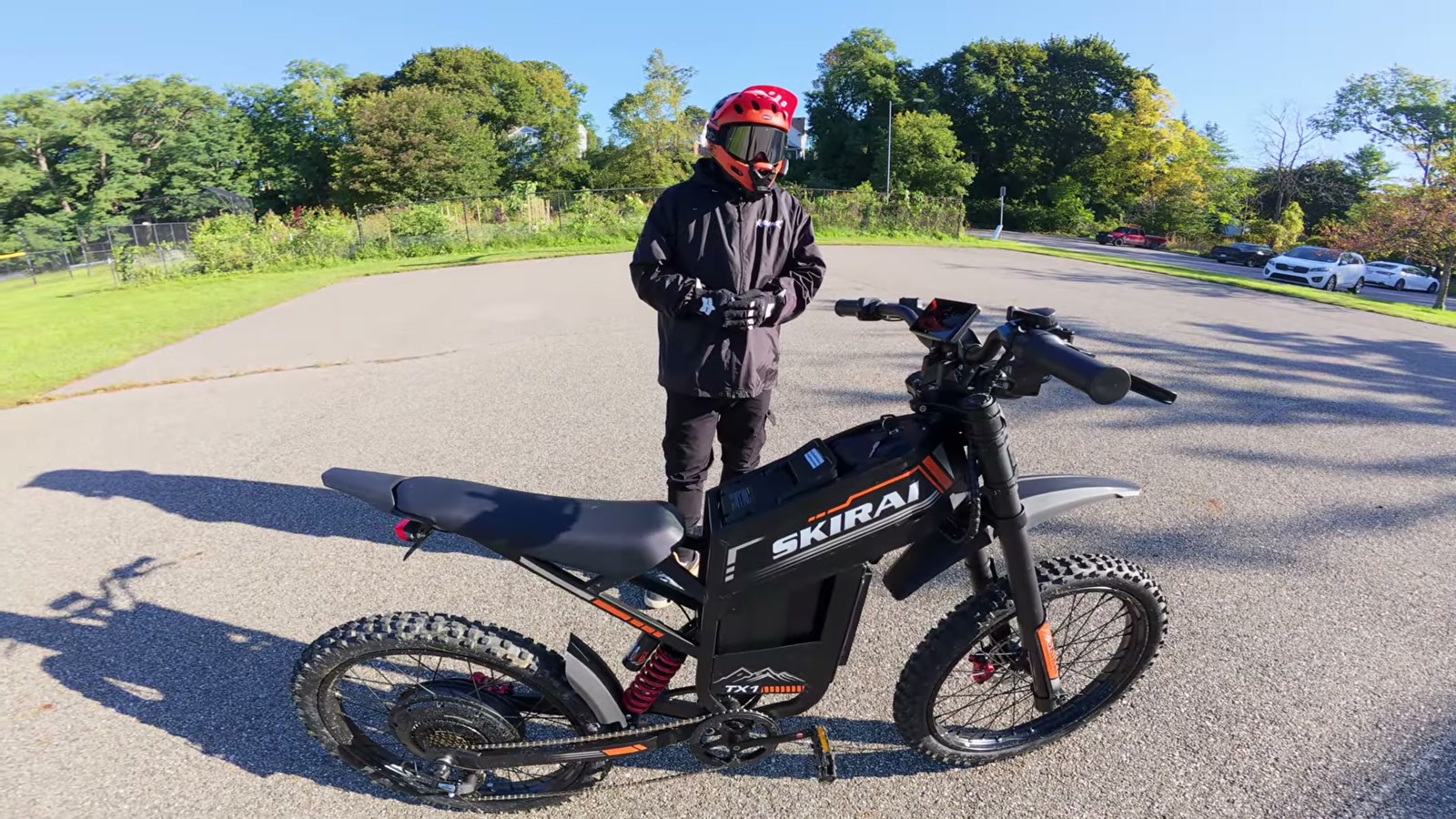
The TX1 fits right into that popular Sur Ron-style silhouette: long saddle, moto-ish stance, and the overall vibe of a lightweight e-moto that happens to include bicycle components.
One of the first things I liked was how solid the cockpit feels. The handlebars use direct mounts connected to the fork rather than the more typical bicycle-style stem setup. In real-world riding, that gives the front end a more planted, secure feel—especially when you’re pushing speed or hitting rougher ground.
Size-wise, it’s a tall-ish bike. With my 30-inch inseam, I couldn’t quite flat-foot it, but it wasn’t awkward either. One foot down is easy, and one foot on a pedal feels natural. The bar position worked, though I’d personally consider riser bars to bring the grips a bit closer.
Build-wise, it has the stuff you’d expect for this category:
19-inch knobby tires front and rear
Full suspension with an adjustable rear shock
Hydraulic disc brakes with thick 180mm rotors
Headlight and a tail light with brake functionality
A center-mounted display
Full twist throttle
It also weighs around 123 lb, and that number matters later when we talk about pedaling and handling.
Controls and daily usability
The startup process is more “moto” than “bike,” which I actually like for this class.
The battery uses a drop-down design with a key lock, plus its own power button and charging port. Then you’ve got a separate key ignition up on the bike. Once it’s powered, it defaults into a park mode—and to get out of park mode, I had to squeeze the brake.
On the bars, I had:
A headlight switch
A horn (and yes, it’s loud)
A Shimano 7-speed shifter
The twist throttle plus a mode switch (Eco and Sport)
One practical note: the display was reading in kilometers per hour. Not a dealbreaker, but it’s something you’ll notice immediately if you’re speed-checking on the fly.
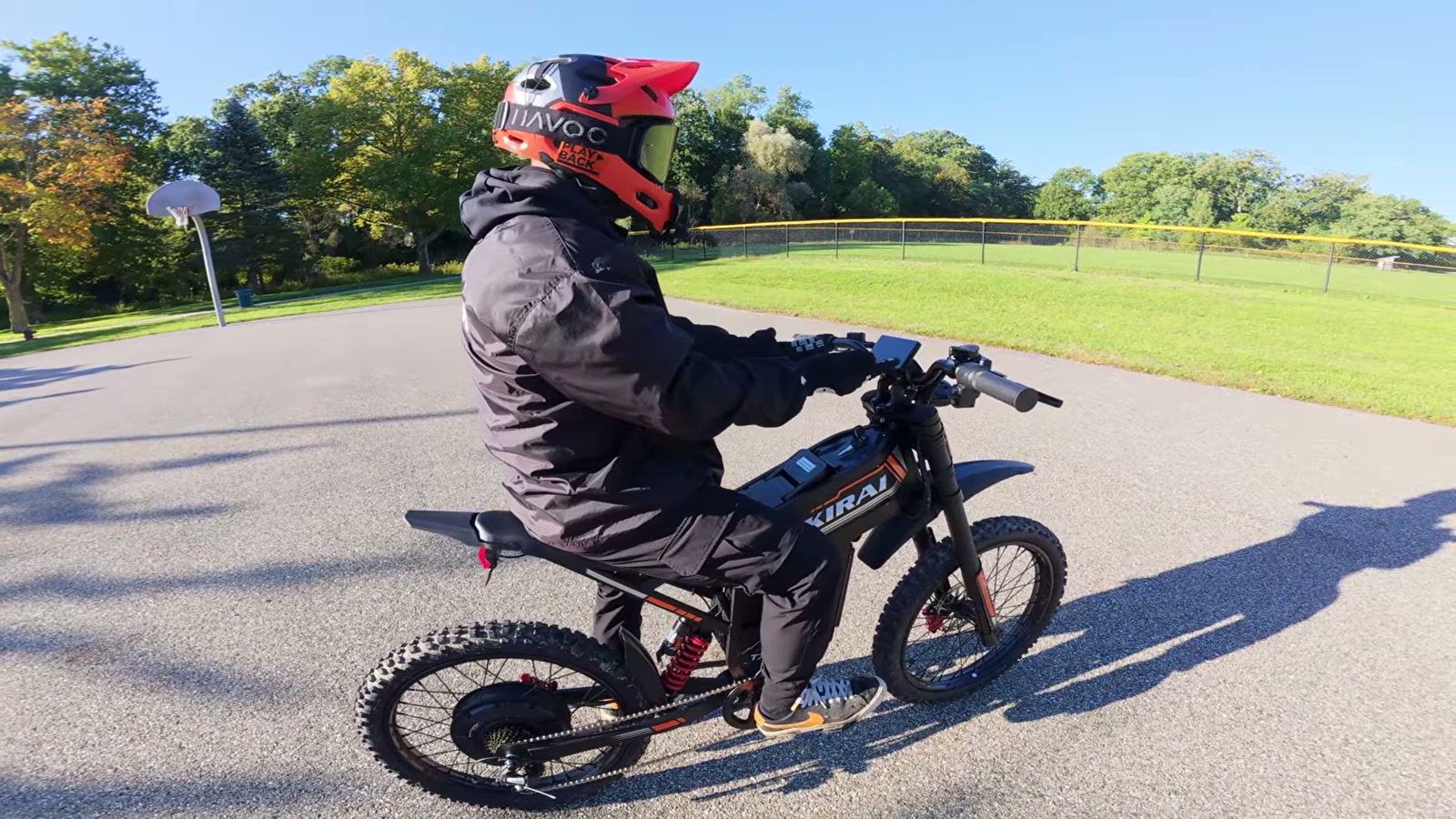
The ride: power delivery and throttle feel
This bike is built around a big rear hub motor rated at 3,000W with a claimed 7,000W peak, paired to a removable 60V 30Ah battery. I’m not here to bench race motor numbers—what matters is what it feels like on the ground.
In Eco mode, the tune is surprisingly manageable. There’s a bit of throttle delay, but it wasn’t scary or unpredictable. After a few minutes, I adjusted to it and could modulate power pretty easily.
In Sport mode, the TX1 wakes up immediately. The low-end power band feels abrupt in the way a lot of high-power hub bikes do: you roll on the throttle and it wants to go now. It’s fun, and the torque is absolutely there, but if you’re brand new to this style of bike, Sport mode will demand a little respect until your right hand calibrates.
The upside is that it feels strong in the places you actually use power—pulling away from a stop, punching up a hill, and accelerating into higher speeds.
GPS top speed test: about 47 mph
I pushed the TX1 in Sport mode and saw around 47 mph at the top end. It also got there with pretty respectable acceleration.
That speed puts it squarely into “this is not your casual pedal-assist commuter” territory. At those speeds, stability, brakes, and suspension matter more than spec-sheet wattage—and that’s where the TX1 has a mix of wins and a couple clear weaknesses.
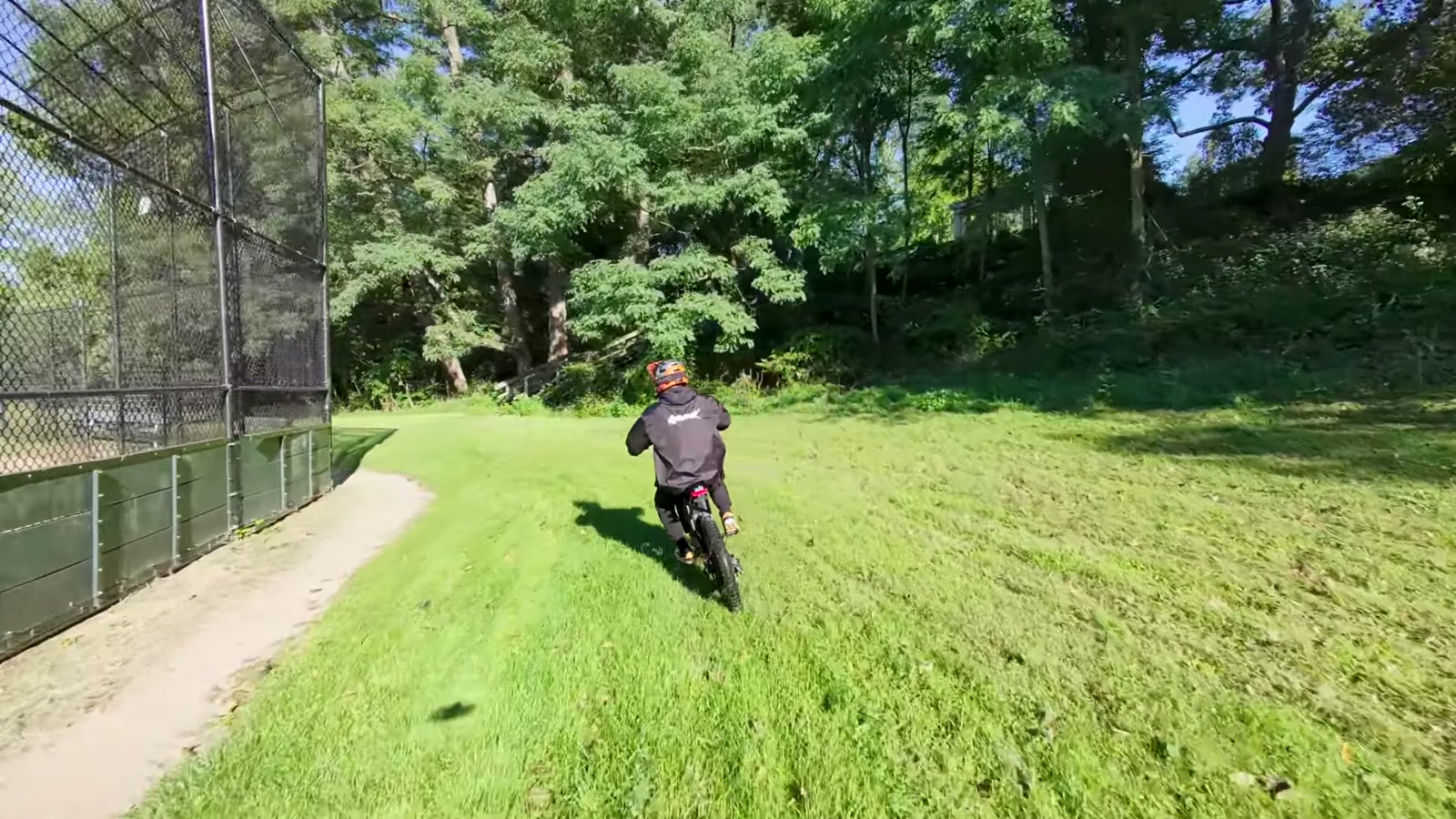
Braking performance
The hydraulic brakes did what I wanted them to do. I was able to lock things up when I needed to, and they offered plenty of stopping power for this platform.
On fast, heavy e-bikes like this, weak brakes can ruin the whole experience. That wasn’t the case here. I didn’t come away thinking brakes were on the upgrade list.
Comfort and suspension (rear: great; front: frustrating)
If you only read one section of this review, make it this one—because suspension is the difference between “I’ll ride this all weekend” and “my wrists are done after 20 minutes.”
The rear shock is legitimately nice. It felt comfortable and did a good job taking the edge off bumps and rough ground. It’s also adjustable, which matters if you want to tune feel for your weight and riding style.
The front fork is the weak link.
On my off-road riding, it felt like the fork was bottoming out over bumps, and I could feel a lot more impact through the front end than I wanted. I didn’t see obvious adjustments up front like you’d expect on a more serious fork, so if you plan to ride off-road often, you should go into the TX1 expecting that the fork may be the first thing you want to improve.
To be clear: the bike is still rideable off-road, and it’s still fun. But the front end was holding the TX1 back from being truly comfortable when the terrain got choppy.
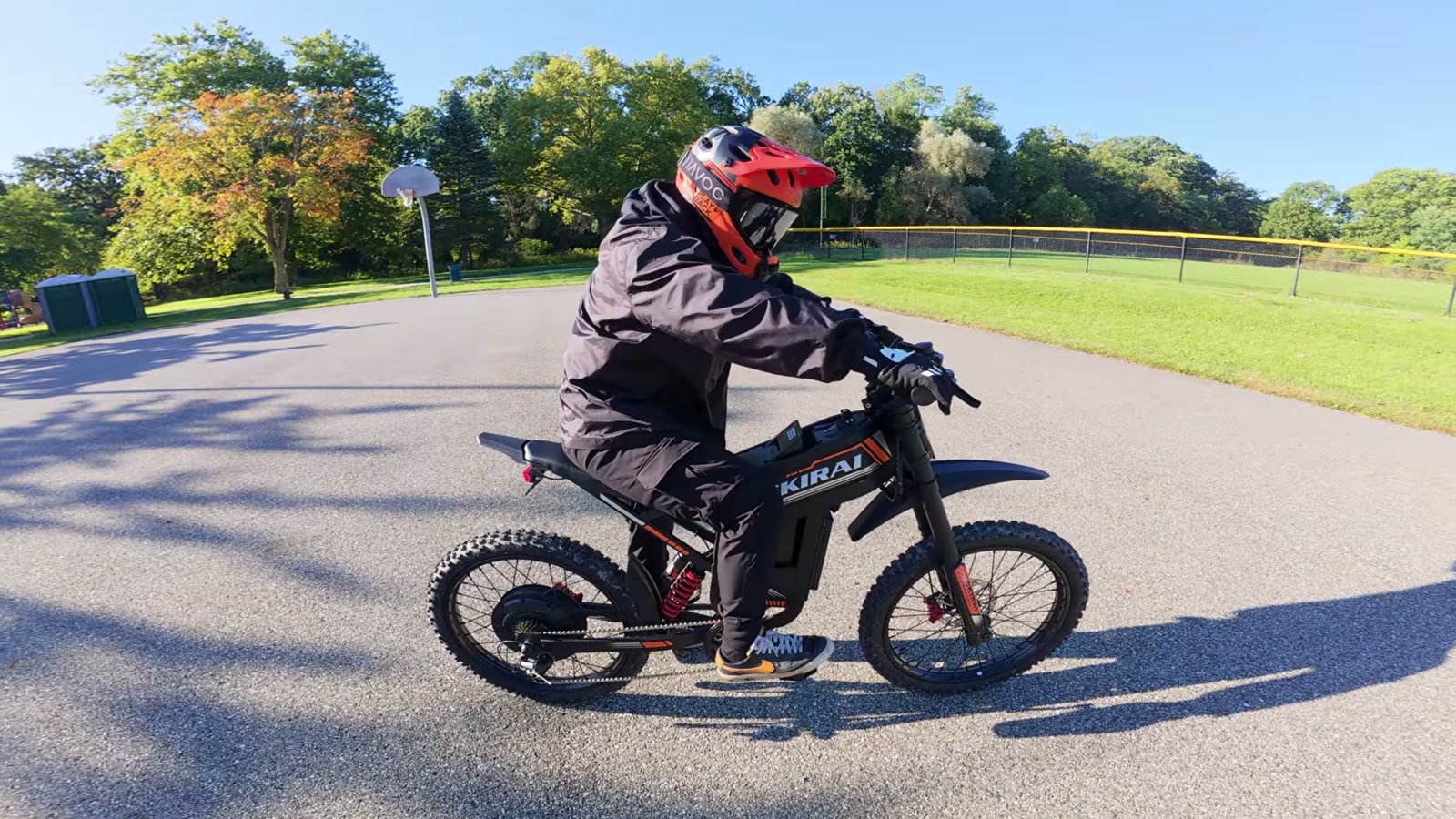
Off-road performance and hill climbing
Power is the TX1’s personality—and off-road is where that personality makes the most sense.
I pointed it at a pretty steep hill and it climbed without drama. The torque is there, and the bike feels like it wants to keep pulling.
On grass and rougher terrain, the 19-inch knobbies hook up well, and the rear suspension helped keep things controlled. I also appreciated having fenders because the TX1 will absolutely throw water and debris when you ride it like it’s meant to be ridden (although I still got plenty wet).
Overall, off-road it rips. The only consistent annoyance was that front fork harshness when it started hitting its limits.
Pedaling and the lack of pedal assist
This is a big one.
The TX1 has standard pedals and a 7-speed drivetrain, but there’s no pedal assist sensor. That means no PAS at all. The drivetrain is basically there if you want to help out at low speeds, limp it home, or contribute lightly—but you’re mainly riding this bike on the throttle.
And because it’s a 123 lb bike, pedaling without throttle help is a workout. On flat ground it’s doable, but it’s not something I’d want to rely on for regular riding.
For some riders, that’s totally fine. A lot of people in this category prefer throttle-only control anyway, because poorly tuned PAS can feel awkward. But if you’re coming from traditional e-bikes and you expect pedal assist to be part of the experience, the TX1 is going to feel like a different species.
Two ride modes feels limiting
You only get Eco and Sport.
Eco is controllable and easy to live with.
Sport is the one you’ll use when you want the TX1 to feel like the high-power machine it is.
But I kept wishing for at least one or two more steps in between—something that lets you fine-tune power for tight trails, neighborhood riding, or learning the bike’s throttle behavior. More power levels would make the TX1 easier to dial in for different situations.
Practical upgrades I’d consider
I’m not saying you need to mod it right away, but the TX1 does feel like a platform you could personalize.
The two things I’d most seriously consider based on my ride time:
Addressing the front fork (it was the most noticeable limitation)
Tweaking rider fit with bars (I’d personally try risers)
Beyond that, you could also go in a more street-oriented direction with different tires, or make comfort changes like adjusting or reworking the seat for grip.
What We Like
Strong low-end torque and punchy acceleration
Around 47 mph top speed in Sport mode
Off-road capability is legit, especially for hill climbs
Rear shock feels comfortable and does a good job absorbing bumps
Hydraulic brakes have plenty of stopping power
Direct-mount handlebars feel secure
Full twist throttle suits the bike’s character
Things To Consider
Front fork tended to bottom out over bumps, especially off-road
No pedal assist, and pedaling a 123 lb bike without throttle help is tough
Only two ride modes (Eco and Sport) feels limiting
Display showing km/h may be an annoyance depending on your preferences
Final thoughts
The Skirai TX1 nails the core reason most people look at bikes like this in the first place: it’s fast, torquey, and genuinely fun off-road. Hitting around 47 mph with solid acceleration makes it feel more like a compact e-moto than a typical e-bike, and the rear shock + hydraulic brakes help it feel capable when you’re actually riding it hard.
The tradeoff is refinement. The front fork held it back on rough terrain, the lack of pedal assist makes the drivetrain feel more like a backup than a feature, and I really wanted more than just Eco and Sport to better shape the ride feel.
If you want a high-powered, throttle-forward electric bike for ripping around, climbing steep hills, and mixing in off-road riding, the TX1 makes a strong case—especially if you already understand this category and its quirks.
If you want a traditional e-bike experience where you can comfortably pedal with assist for longer rides or commuting, this isn’t that. It’s a different tool for a different kind of rider.