

Ariel Rider Grizzly 72V Review: Fast, Heavy, and Surprisingly Smooth
October 21, 2026
Some links in this article may be affiliate links. If you buy through them, we may earn a small commission at no extra cost to you.
The Ariel Rider Grizzly 72V is the kind of e-bike that immediately resets your definition of “e-bike.” It’s big, heavy, and unapologetically powerful—and yet what surprised me most wasn’t the speed.

It was how smooth and controllable it feels when you’re not trying to ride it like a rocket.
I tested the Ariel Rider Grizzly 72V (Private Property Edition), which is the version designed to be unlocked for higher speed. That “Private Property” part matters, because bikes like this are right in the middle of a shifting legal landscape. More on that later. But purely as a riding machine? The Grizzly 72V feels less like a bicycle and more like a light electric moped that happens to have pedals.
First Impressions: This is basically a moped with pedals
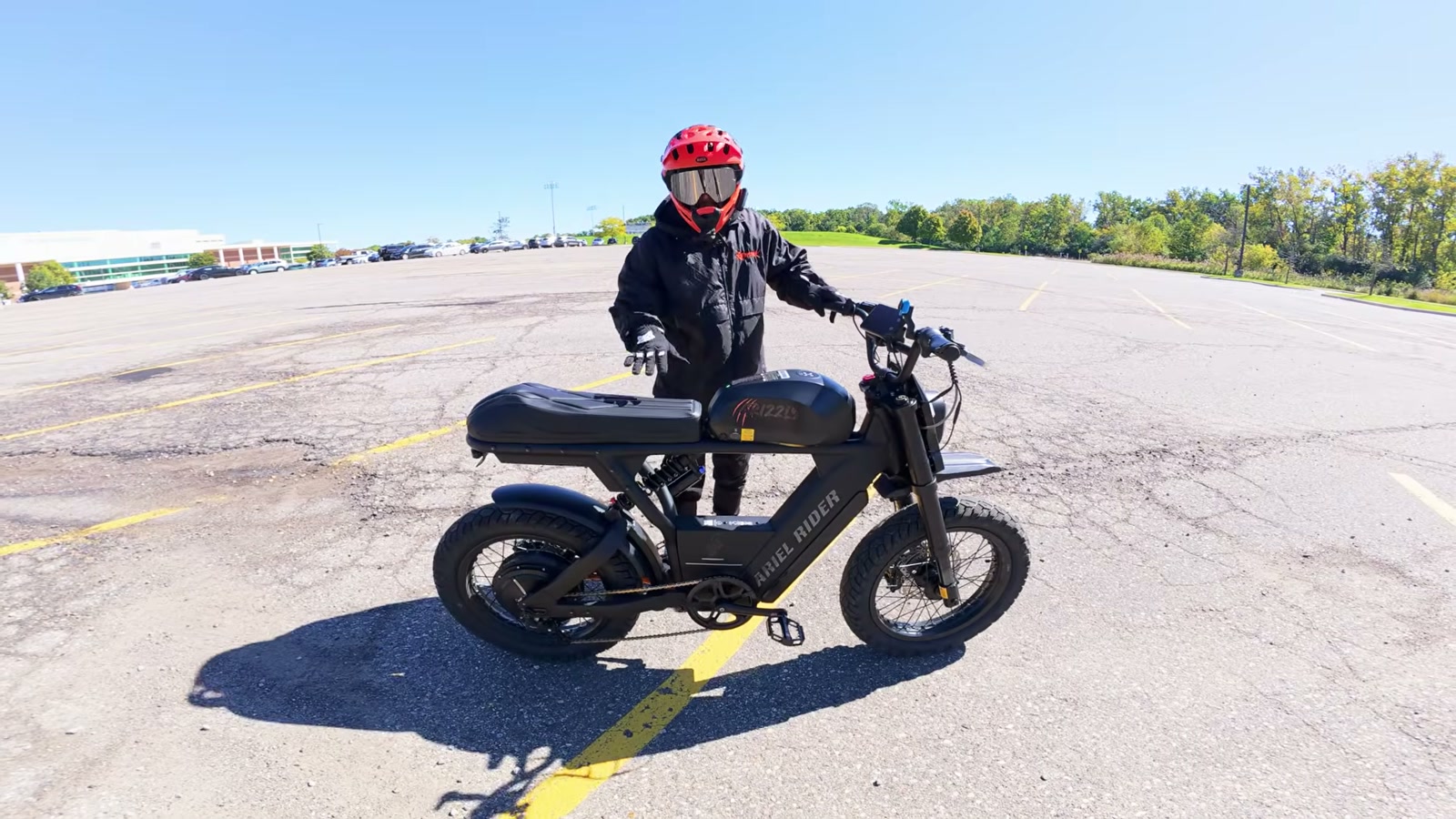
The first thing you notice is the presence. Between the long moped-style frame, chunky 20x4.5 tires, and the overall mass, the Grizzly doesn’t pretend to be a casual commuter bike.
At around 180 pounds, it’s in a different category from most fat-tire e-bikes. Even before you ride it, you feel that weight in the way it stands, the way it rolls, and the way you think about where you’re going to store it.
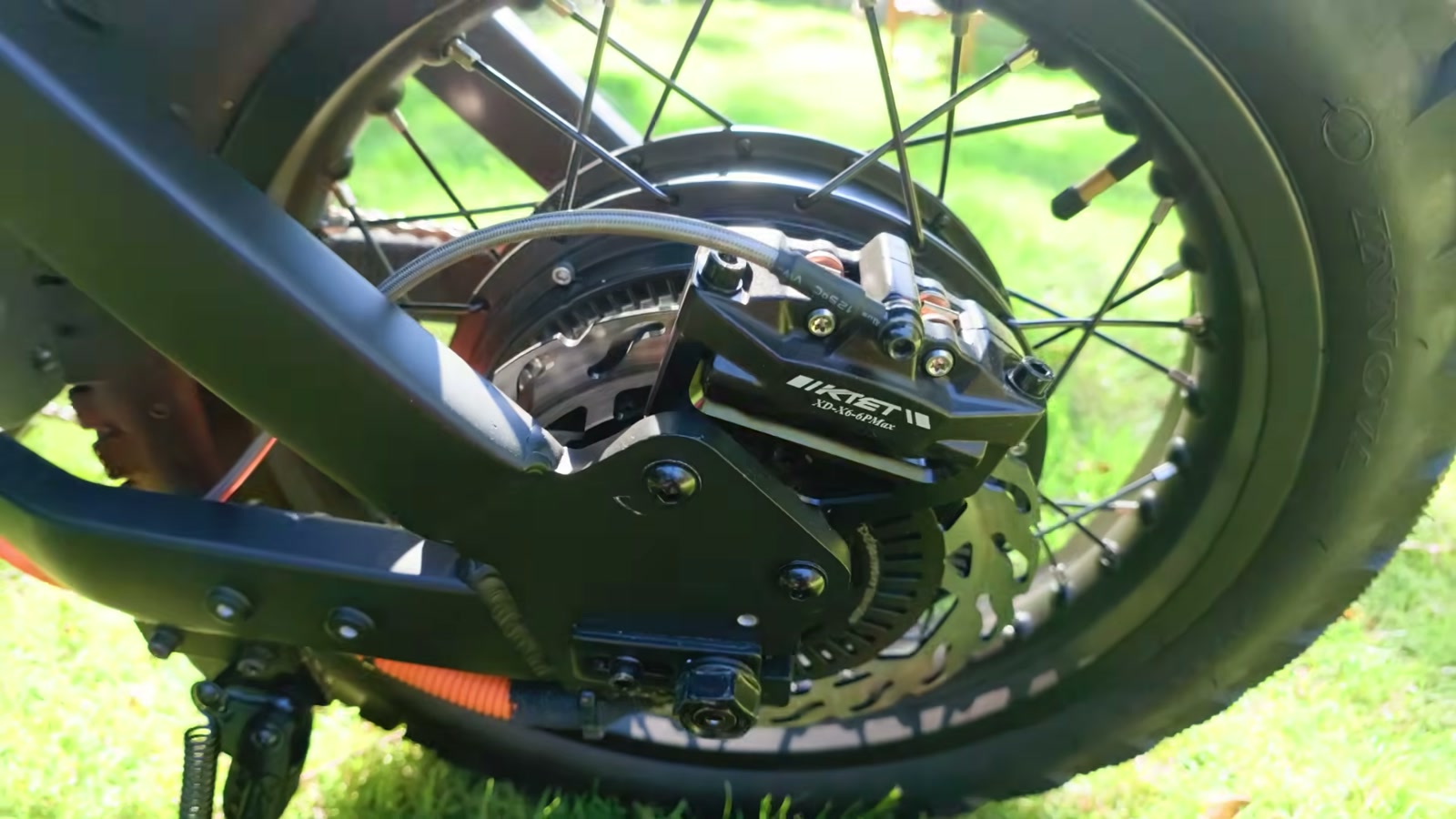
A big part of the Grizzly’s identity is that rear hub motor: a 3,000W rated, oil-cooled unit that Ariel Rider says can peak up to 8,000W. You can even see the oil level indicator port on the motor. That’s not a common detail on e-bikes, and it hints at what this thing is built for: sustained power without cooking itself.
The rest of the build matches the vibe.
The tires look and feel more like moto tires than bicycle tires, with a dual-sport style tread.
The brakes are motorcycle-style hydraulic disc brakes with six pistons and 220mm rotors front and rear.
The suspension is full and adjustable, with a beefy front fork (Ariel Rider lists 100mm travel) and a Fast Ace rear shock.
And then there’s the dual-battery setup: one battery sits in the down tube, and another sits up top in a “gas tank” style position. Combined, Ariel Rider rates the system at 72V, 45Ah (3,240Wh), using Samsung 21700 cells.
This is not a bike you buy because you want to pedal a lot. It’s a bike you buy because you want power on tap.
Setup quirk: make sure both batteries are actually on
One quick real-world tip: each battery has its own power button.
I initially had a “why isn’t it turning on?” moment until I realized you need to activate each battery with a long press on its button. If you ever run into a dead-looking bike out of the box, that’s the first thing I’d check.
The flip side is that removable batteries are a genuine quality-of-life benefit here. Even if the bike is still heavy with the batteries removed, it’s at least more manageable when you need to transport it.
Controls, modes, and a display I actually like
Ariel Rider uses a three-mode setup—Eco, Sport, and Boost—and you can pair those with multiple pedal assist levels (the menu lets you pick how many PAS levels you want; I set mine to five).
In practice, that gives you a ton of ways to tune the bike to the moment.
Eco is what I’d use around pedestrians, bike paths, and slow maneuvering.
Sport adds punch, especially off the line.
Boost is where the Grizzly becomes the Grizzly.
The half-twist throttle works fine, though on something this powerful I’d personally prefer a full twist for better hand comfort on longer high-speed runs.
My favorite surprise feature is the display. It has a matte, anti-glare look that reminds me of e-ink—easy to read in bright sun, not the typical shiny LCD that washes out. It’s also more than a speedometer: it includes built-in features like a front-facing camera for loop recording (dash cam style) if you add an SD card. That’s an unusual add-on in the e-bike world, and while I didn’t fully set it up for a deep test, I love the direction.
You also get integrated lighting, turn signals (with an audible clicking like a car), a bright headlight, and a loud moto-style horn. When you squeeze the brakes, the rear light brightens like a real brake light, and the turn signals automatically cancel.
That kind of integration matters more than people think—especially on a bike that can move quickly in real traffic.
Ride Experience: the Grizzly’s best trick is how refined it feels
Getting rolling and low-speed control
Because the bike is heavy and uses a cadence-based system (the display shows cadence), getting started from a dead stop takes a little momentum. Once you’re moving, though, the pedal assist feels surprisingly natural.
Eco mode in particular is dialed in well. The power comes on in a way that matches what I’m doing rather than blasting me forward unexpectedly, and when I stop pedaling it backs off cleanly. That “off” behavior matters—some cadence setups keep pushing for a moment after you stop, and that can feel sketchy in tight spaces.
At slow speeds, the Grizzly is genuinely easy to manage. That’s where the weight melts away a bit, because the motor assistance is doing exactly what you want: just enough.
Acceleration and throttle response
In Boost mode, it wakes up fast.
What impressed me is the ramp-up. It’s quick, but not sloppy. The power delivery feels smooth and responsive, and it’s easy to modulate once you adapt to how much thrust it has.
If you’re not ready for it, you can still get that “whoa” moment—there’s real torque here. But it never felt uncontrollable to me. It felt like a powerful setup with a decent tune, not a janky on/off switch.
And past about 20 mph, the Grizzly becomes what I expected it to be: more throttle-first than pedal-first. With a single-speed drivetrain, you’re basically ghost pedaling once you’re moving at speed. The pedals feel more like “compliance pedals” than the primary way you’re going to ride.
GPS speed testing: I saw about 50 mph
I did unlock the speed limit through Ariel Rider’s process (Private Property Edition, waiver/consent, password to adjust speed settings). Even with that done, in my testing I was hitting about 50 mph.
Ariel Rider advertises over 60 mph when unlocked for off-road use, so I expected to see something higher. It’s possible there’s another setting or another condition needed to reach that number, but based on what I was able to get set up and tested, around 50 mph was the ceiling I consistently saw.
Even at 50, it’s seriously fast for something with bicycle bars and a saddle seat.
Suspension comfort: better than I expected
This is where the Grizzly won me over.
I rode it on rough, cracked pavement and pothole-riddled sections where you normally brace your arms and hover off the seat. The combination of the fat tires, the adjustable front fork, and the Fast Ace rear shock makes the bike feel unusually composed.
It doesn’t just take the edge off—it actually settles the bike down. Over broken pavement, it felt like the suspension was doing real work rather than just existing for the spec sheet.
The saddle seat also helps. It’s thick, grippy, and shaped with a rear hump that keeps you planted when you roll into the throttle.
Handling: stable like a small motorcycle
Those big 4.5-inch tires and the overall weight give the Grizzly a more moto-like feel in turns. It’s not “hard to turn,” but it doesn’t feel flickable like a lightweight e-bike.
The stability is a plus at speed—you want a bike like this to feel planted. But it’s also something to keep in mind if you’re expecting a nimble bicycle experience.
Braking: the kind of stopping power this weight needs
A 180-pound e-bike that can run up to high speed needs real brakes, and the Grizzly delivers.
The six-piston hydraulic setup with 220mm rotors feels appropriately serious. When I got on the brakes, it slowed down with authority. It feels like Ariel Rider understood the assignment here: if you’re going to build a heavy, fast machine, you can’t cut corners on the parts that bring it back down to earth.

Light off-road: more capable than its vibe suggests
With the dual-sport tread, full suspension, and loads of torque, the Grizzly does better off-road than I expected.
I took it onto grass and rougher terrain and it stayed comfortable—absorbing bumps cleanly and keeping traction. This isn’t a technical trail bike, and I’m not pretending it is. But for cutting through a park, handling dirt paths, rolling over uneven ground, and dealing with bad roads, it felt very capable.
The power makes hill climbing feel like a non-issue. As long as you’re smart about traction and surface conditions, it has the muscle to keep moving.
Real-world use cases: where this bike makes sense
As a commuter (if you’re realistic about legality)
As a commuter, the Grizzly makes a ton of sense if what you really want is a light electric moped experience.
The integrated lights, turn signals, and horn are the kinds of things I want if I’m mixing with traffic. The smooth tune and multiple ride modes also mean you can chill in Eco when you’re around people and then open it up where it’s appropriate.
Depending on where you live, there’s also the possibility of registering something like this as a moped. In my case (Michigan), that’s not an outrageous idea if you’ve got the required equipment like signals and a horn and you keep it within the limits.
But you absolutely have to do your homework. Unlocked, this is outside typical e-bike classifications.
As a fun machine for private property rides
If you have land, access to private roads, or off-road areas where it’s allowed, the Grizzly feels purpose-built for that.
It’s the kind of bike you can ride for the thrill of acceleration, the comfort of suspension, and the “mini motorcycle” feel—without committing to a full motorcycle.
Cargo potential (with the right setup)
The frame includes mounting points that look ready for a rack, which could make this genuinely practical for hauling gear. I like seeing that on a bike this powerful, because it hints at using the Grizzly as a utility machine, not just a toy.
What We Like
Big, satisfying torque with strong acceleration
Smooth, controllable power delivery (especially for how powerful it is)
Full suspension and fat tires make rough roads feel dramatically better
Six-piston hydraulic brakes with big rotors feel confidence-inspiring
Matte, easy-to-read display with extra features like loop recording support
Integrated lights, turn signals, and a properly loud horn
Things To Consider
It’s extremely heavy (around 180 lb), which changes the storage/transport conversation completely
Single-speed drivetrain means you’re ghost pedaling above roughly 20 mph; throttle becomes the main tool at speed
Even unlocked, I topped out around 50 mph in my testing—not the 60+ mph that’s advertised
Legal status can get complicated fast when you unlock the speed; check your local laws before riding on public roads

Final Thoughts: A powerful, comfortable e-moped vibe—just be honest about what it is
The Ariel Rider Grizzly 72V feels like Ariel Rider stepping fully into the high-power category with a more integrated, refined setup than the DIY-style 72V conversions a lot of us used to do.
If you’ve ridden bikes like an Onyx-style machine or you’re already comfortable with 72V performance, you’ll feel right at home. The biggest wins for me were the smooth tune, the comfort, and the braking—because those are the things that make big power actually usable.
If you’re looking for a traditional e-bike that you’ll carry up stairs, pedal for exercise, or treat like a lightweight commuter, this isn’t it. The Grizzly is a heavy, fast, moped-like machine. You need the storage space for it, and you need a plan for how (and where) you’re going to ride it legally.
As long as you go into it with that mindset, the Grizzly 72V is an absolute blast.